
Nov 19, 2024Updated Sep 10, 2026
How to Share Power BI Reports with External Users Without a Pro License (2026)
ByVlad Mihanta

How to Share Power BI Reports with External Users Without a Pro License
You have reports in Power BI and people outside your organization who need to see them: customers, partners, suppliers, board members. The first thing most teams discover is that Power BI's own sharing features assume every viewer has a Power BI license, and since April 2025 a Pro license costs $14 per user per month.
There are five ways around this. Some cost nothing but expose your data. Some are secure but cost more than the licenses would have. One lets any number of external viewers use your reports with no Power BI license at all. This guide walks through all five, with the licensing rules as Microsoft documents them in 2026, so you can pick the right one for your situation. For a side-by-side table of every option, including licence per viewer and security, see ways to share Power BI externally.
There are five ways around this. Some cost nothing but expose your data. Some are secure but cost more than the licenses would have. One lets any number of external viewers use your reports with no Power BI license at all. This guide walks through all five, with the licensing rules as Microsoft documents them in 2026, so you can pick the right one for your situation. For a side-by-side table of every option, including licence per viewer and security, see ways to share Power BI externally.
The short version
| Option | Viewer needs a license? | Secure? | Best for |
|---|---|---|---|
| 1. Share to a guest user | Yes, Pro or PPU (unless F64+) | Yes | A handful of external people |
| 2. F64 or larger capacity | No (Free license + viewer role) | Yes | Large organizations already on F64 |
| 3. Publish to Web | No | No, public to anyone with the link | Non-sensitive, public data only |
| 4. Power BI Embedded (app owns data) | No, on any capacity size | Yes, with RLS | Customer and partner portals at scale |
| 5. Scheduled export by email | No | Yes, but static | Recurring reports, no interaction needed |
Option 1: Share directly to an external guest user
The Power BI service lets you share a report or app with an external email address. Behind the scenes the person is invited into your tenant as a Microsoft Entra B2B guest, signs in with their own Microsoft account, and opens the report in the normal Power BI interface.
It works, and for two or three people it is the quickest path. The catch is licensing. Microsoft's rule is simple: the recipient needs a Power BI Pro or Premium Per User license unless the content sits on a Premium (P) or Fabric F64 or larger capacity. Either you buy and assign the license, or the guest's own organization already has one. At $14 per Pro license per month, twenty external viewers cost $3,360 a year before anyone has looked at a chart.
It works, and for two or three people it is the quickest path. The catch is licensing. Microsoft's rule is simple: the recipient needs a Power BI Pro or Premium Per User license unless the content sits on a Premium (P) or Fabric F64 or larger capacity. Either you buy and assign the license, or the guest's own organization already has one. At $14 per Pro license per month, twenty external viewers cost $3,360 a year before anyone has looked at a chart.
Other limits worth knowing
- Access management. Every guest is an object in your Entra tenant. Onboarding, offboarding and reviewing who still has access becomes an admin job that grows with your customer list.
- Branding. Guests land in Power BI, not in your product. You cannot change the look, add your own navigation, or put anything next to the report that isn't Power BI.
- Tenant settings. External sharing has to be allowed by your Fabric admin, and many organizations lock it down.
Option 2: Put the content on an F64 or larger capacity
Microsoft's licensing model has one threshold that matters here. On a Fabric capacity of F64 or larger (and on the retiring Premium P SKUs), users who only hold a Free license can view Power BI content if they have the viewer role on the workspace. That includes B2B guests. On anything smaller, F2 through F32, every viewer still needs Pro or PPU.
So if your organization already runs an F64, sharing with external guests costs you no extra licenses. If it doesn't, the arithmetic rarely works: an always-on F64 is roughly $8,400 per month at US pay-as-you-go list price, or around $5,000 per month on a one-year reservation. You would need several hundred external viewers before that beats buying Pro licenses, and the guests still land in the standard Power BI interface with all the branding and admin limits from option 1.
So if your organization already runs an F64, sharing with external guests costs you no extra licenses. If it doesn't, the arithmetic rarely works: an always-on F64 is roughly $8,400 per month at US pay-as-you-go list price, or around $5,000 per month on a one-year reservation. You would need several hundred external viewers before that beats buying Pro licenses, and the guests still land in the standard Power BI interface with all the branding and admin limits from option 1.
Option 3: Publish to Web
Publish to Web generates a public link and an iframe snippet for a report. Nobody needs a license, nobody needs to log in, and it is genuinely the right tool for a public annual report or a live statistics page on your website.
It is the wrong tool for anything else, because the security model is: there is none.
It is the wrong tool for anything else, because the security model is: there is none.
Why it fails for customer data
- Anyone with the link sees everything. Even if you embed the iframe on a password-protected page, the iframe source is visible in the page code and works anywhere.
- No row-level security. RLS is not applied to Publish to Web reports. Every viewer sees the full dataset.
- Often disabled. Because of the above, many Fabric admins turn the feature off tenant-wide.
Option 4: Power BI Embedded, the app-owns-data model
This is the option built for exactly this problem. Microsoft's embedded analytics documentation describes two models. Embed for your organization (user owns data) is for internal users who sign in with their own Power BI identity and need a license. Embed for your customers (app owns data) is for external users, and Microsoft's own wording is: "there are no licensing requirements for the end users."
How it works: your application authenticates against Power BI with a service principal, requests an embed token for a specific user, and renders the report inside your own web page. The viewer never touches the Power BI service. They log in to your portal with whatever identity you choose, and Power BI never asks them for a license.
How it works: your application authenticates against Power BI with a service principal, requests an embed token for a specific user, and renders the report inside your own web page. The viewer never touches the Power BI service. They log in to your portal with whatever identity you choose, and Power BI never asks them for a license.
What makes it different from the other options
- No per-viewer license, at any capacity size. The F64 threshold from option 2 does not apply to app-owns-data embedding. An F2 or an A1 capacity serves unlicensed external viewers just as legitimately as an F64 does. Only the people who author and publish reports need Pro or PPU.
- Row-level security works. The embed token carries the RLS roles for that user, so a customer sees only their rows even though everyone shares one report. Our guide to RLS in Power BI Embedded covers the setup.
- Your branding, your domain, your login. Because the report lives inside your application, everything around it is yours: navigation, colors, custom domain, additional pages, and the identity provider your customers already use.
- Unlimited scale. You size the capacity for concurrent load, not for headcount. Going from 50 customers to 5,000 changes your capacity bill, not your license count.
What it costs
You pay for a capacity, billed while it runs, and for whatever you build or buy around the API. A small customer portal can start on an F2 at roughly $263 per month always-on at US list price, and far less if the capacity is paused outside business hours. Our 2026 pricing guide has the full numbers for F and A SKUs.
Compare that with 100 external viewers on Pro licenses: $1,400 per month, $16,800 per year, and it keeps climbing with every customer you add.
Compare that with 100 external viewers on Pro licenses: $1,400 per month, $16,800 per year, and it keeps climbing with every customer you add.
The catch: someone has to build the application
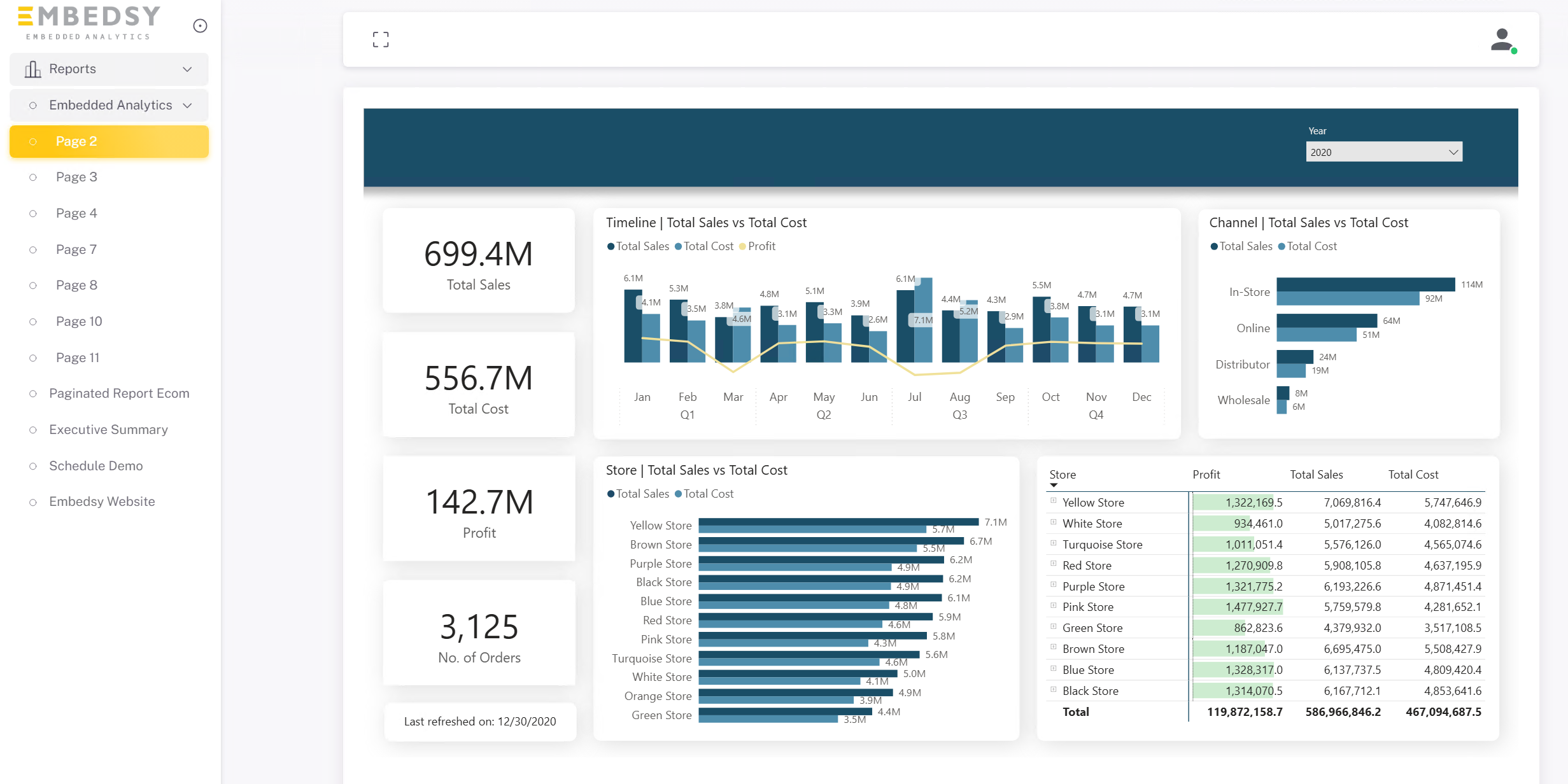
The API gives you an embedded report. It does not give you user management, roles, tenant isolation, a branded interface, capacity pause and resume, or scheduled exports. You either build that layer (our build vs buy post covers what that involves) or use a portal product that already has it. The Embedsy Portal is that layer: it installs into your own Azure subscription from install.embedsy.io, connects to your existing workspaces, and gives external users a branded login with roles, RLS and page-level access already wired up.
Option 5: Send the report by email on a schedule
Sometimes external stakeholders don't need to click around. A monthly board pack, a weekly supplier scorecard or a quarterly client review is often better as a PDF that arrives in the inbox. Power BI's own email subscriptions only go to licensed users in your tenant, but scheduled exports from an embedded solution can go to anyone.
The Embedsy Portal's Report Scheduling renders a report as PDF, PowerPoint, PNG or Excel and emails it to recipients with or without a portal account. It respects RLS per recipient, so one schedule can send each customer their own numbers. Our post on scheduling Power BI reports to external users goes into detail. Static means no filtering or drill-down, which is either a limitation or exactly what you want.
The Embedsy Portal's Report Scheduling renders a report as PDF, PowerPoint, PNG or Excel and emails it to recipients with or without a portal account. It respects RLS per recipient, so one schedule can send each customer their own numbers. Our post on scheduling Power BI reports to external users goes into detail. Static means no filtering or drill-down, which is either a limitation or exactly what you want.
Which one should you choose?
- Two or three known people, occasionally: share to a guest and buy the licenses. Not elegant, but done in ten minutes.
- You already own an F64: use it. Guests with Free licenses can view, and you pay nothing extra.
- The data is public anyway: Publish to Web, or a secured public embed if you want any control at all.
- Customers, partners or a product, at any scale: Power BI Embedded with the app-owns-data model, through a portal. This is the only option where the cost stops tracking headcount and the experience is yours.
- Recipients only need the numbers, not the interaction: scheduled export by email, alone or alongside a portal.
Frequently asked questions
Do external users need a Microsoft account?
Not with the app-owns-data model. Your portal decides how people sign in. The Embedsy Portal supports Microsoft Entra ID, including Entra groups mapped to roles, and other providers such as Google sign-in, so a customer can use the account they already have.
Do I still need any Pro licenses at all?
Yes, a few. Microsoft requires a Pro or PPU license (or a service principal) for anyone who publishes content to a workspace and for admins managing the tenant and capacity. In practice that means your report authors, not your viewers.
Does row-level security really work for external viewers?
Yes. The embed token is generated per user with their RLS roles, and the Power BI engine filters the data before it reaches the browser. The report itself is shared; the rows are not.
Is an A SKU or an F SKU better for this?
Both serve unlicensed external viewers. F SKUs bill per second, support Direct Lake and can be reserved for a discount; A SKUs bill hourly and are simple if embedding is all you do. Our post on the A SKU retirement question compares them.
Key takeaway
Power BI's built-in sharing was designed for colleagues, and its licensing follows that assumption. The moment your viewers are customers or partners, the app-owns-data embedding model is the one Microsoft built for the job: no per-viewer license on any capacity size, full row-level security, and an experience that belongs to you rather than to Power BI.
If you want to see what that looks like without building it, the Embedsy Portal has a 30-day free trial and installs into your own Azure environment.
If you want to see what that looks like without building it, the Embedsy Portal has a 30-day free trial and installs into your own Azure environment.
Related reading
Sep 10, 2026
How to Build a White-Label Power BI Portal for Your Customers (2026)

Pascal Kiefer

Jul 23, 2026
How to Schedule & Email Power BI Reports to External Users (Without a License)
Pascal Kiefer

Aug 20, 2024Updated Sep 10, 2026
Power BI Embedded Pricing in 2026: What a Capacity Really Costs
Pascal Kiefer